
'The structural story of India is a multi-decadal story.' 'One should stay invested in that story and avoid reacting to what is happening globally.'
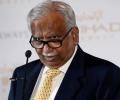
The Enforcement Directorate late on Friday arrested Jet Airways founder Naresh Goyal in a money laundering case linked to an alleged bank fraud of Rs 538 crore at the Canara Bank, official sources said.

'Within India, people want high-quality, personalised banking services, and the demand for such services has exploded.'

The government must set up a Bank Investment Company to shrink its role in PSBs, if we are serious about tackling the two persistent issues - lax corporate governance practices and discretionary decision-making, says Shyamal Majumdar.

Food and grocery delivery major Zomato has pulled the plug on its plan to enter the lending business. Zomato Financial Services, a wholly-owned subsidiary of Zomato, has withdrawn its application for a non-banking financial company (NBFC) licence with the Reserve Bank of India (RBI), stating that the company does not have plans to pursue lending in the future. "There is no material impact on the revenue/operations of the company and this disclosure is being made voluntarily," the Gurgaon-based company said in a regulatory filing on Tuesday.

The RBI under former governor Shaktikanta Das resisted pressures to cut interest rates through 2024 as it kept its 'Arjuna's eye' trained on inflation, but the central bank under a new detail-oriented head will soon have to take a call if it can continue sacrificing growth. Das, a career bureaucrat who in 2016 oversaw Prime Minister Narendra Modi's highly disruptive demonetisation move, left a lasting legacy as he demitted office towards the end of 2024 after expertly navigating monetary policy for six years, the highlight of which was steering India's recovery through the pandemic.

Of the three major Budget announcements related to the banking sector, privatisation of PSBs is the most audacious, says Tamal Bandyopadhyay.

The sharp pullback in mid and smallcap stocks signals a cooling-off period in segments that previously attracted considerable investor interest.

'Unless a comedian is involved in something society deems unforgivable...'

Sashidhar Jagdishan, managing director and chief executive officer of HDFC Bank, the largest private-sector lender of the country, has just completed his first term. The period October 2020-October 2023 was a roller coaster, and the second one, which started on October 27, could be more interesting as the lender absorbs the impact of the merger of HDFC, which was integrated on July 1, and moves to the next growth phase. Soon after he took over the reins from Aditya Puri on October 27, 2020, the Reserve Bank of India (RBI) debarred HDFC Bank from enrolling new credit card customers and launching new products under the Digital 2.0 programme due to repeated outages on its mobile-banking and internet-banking platforms.

The Centre may overshoot the Rs 56,260 crore target for dividend receipts from central public-sector enterprises (CPSEs) set for FY25 and is likely to end up getting around Rs 65,000 crore this financial year, according to a senior government official. This excludes dividend from nationalised banks and financial institutions. As on October 21, the Centre collected Rs 28,913 crore as dividend and other investment from CPSEs, accounting for over 50 per cent of the Budget Estimate for FY25.

Trumponomics, poor growth, and high valuation certainly don't make a bullish recipe for Indian markets, warns Debashis Basu.

The third-quarter financials didn't excite market watchers. But equity investors can still make money if they invest in the right stocks.

This issue was discussed at the Gyan Sangam addressed by Prime Minister.

The target was for banks to sell Rs 2 trillion worth of non-performing assets to NARCL, the so-called 'bad bank, by 2021-2022. Only 10 per cent of this has been executed.

Banks are allowed to invest up to 10 per cent of the paid-up or unit capital in Category-I or Category-II Alternative Investment Funds

Addressing a session at the Future Investment Initiative 2019 here, Modi said India offers a huge investment opportunity in the infrastructure sector also as he emphasised that the country aims to be a $ 5 trillion economy in the next five years.

Union Bank of India , a mid-sized state-owned lender, has plans to expand into investment banking to tap a growing global market in which increasingly aggressive Indian companies are acquiring foreign rivals.

Stock market investors became richer by a whopping Rs 77.66 lakh crore in 2024, helped by an overall optimistic trend in equities, where the BSE Sensex surged over 8 per cent. Analysts said the year witnessed a tug of war between the bulls and bears marked by volatility but, despite the uncertainties around the world, the Indian markets sustained the pressure and delivered impressive returns.

'Over the next 12 months, it will be difficult to make 15 to 20 per cent return in the markets as the valuations appear stretched.'
Japan's Softbank investment arm Softbank Vision Fund exited from Paytm in the June quarter at a loss of around $150 million, sources aware of the development said. Softbank invested about $1.5 billion in One97 Communications -- the owner of Paytm brand -- in tranches in 2017. "Softbank has exited Paytm at a loss of 10-12 per cent.
Swiss authorities have frozen more than $310 million in funds across multiple Swiss bank accounts as part of money laundering allegations into Adani Group, US-based short seller Hindenburg Research claimed citing media report - a charge that the conglomerate vehemently denied. In a post on X, Hindenburg cited "newly released Swiss criminal records reported by Swiss media outlet" to state that "Swiss authorities have frozen more than $310 million in funds across multiple Swiss bank accounts as part of a money laundering and securities forgery investigation into Adani, dating back as early as 2021."

The government is planning to introduce legislative changes to the Foreign Exchange Management Act (Fema) regulations, with a focus on easing the pathway for inflows from a foreign portfolio investor to transition seamlessly into foreign direct investments (FDI) once the FPI surpasses the 10 per cent ownership threshold in a company. This move stems from multiple requests by foreign investors seeking to streamline the reporting requirements that arise when their stakes in Indian firms cross the 10 per cent mark.

In 2024, the National Payments Corporation of India (NPCI) approved 20 third-party Unified Payments Interface (UPI) applications, a record since UPI's launch in 2016. This surge reflects growing interest from financial technology (fintech) companies, driven by the integration of credit products like UPI-linked credit cards and pre-approved credit lines.

The fund will promote domestic shipbuilding of all types and sizes to reduce India's dependence on foreign ships.

More than 50 per cent of SIP accounts come from semi-urban and rural areas.

Quarterly earnings from corporates, global trends, and trading activity of foreign investors will guide market sentiment this week, analysts said, adding that benchmark indices may face volatile trends. "The upcoming release of Q2 results will be closely watched, providing insights into corporate performance. "Meanwhile, the escalating tensions between Israel and Iran introduce a significant geopolitical risk, potentially leading to increased oil prices and market volatility.
In a mixed bag for HDFC Bank ahead of the parent HDFC's merger with itself, the Reserve Bank of India has declined to make exceptions on certain aspects, and has offered some leeway on others. The country's largest private sector lender, which is aiming to conclude the merger with the home finance major by July, had written to the central bank seeking certain forbearances after announcing the $40-billion merger in April last year. In an exchange filing this evening, HDFC Bank said it received a response from RBI on Thursday and also said that there are a few pending issues.

'While investors need to be prepared for making some losses, they should not lose big money chasing euphoria amid fear of missing out.'

Dwaipayan Bose examines the seven important factors that investors about exchange traded funds must know before they start investing/trading in them.

The rally in PSBs, analysts feel, was more a knee-jerk reaction to the development, and the actual benefits will start to accrue once the addition takes place in 2024. "The actual benefit for banks from the inclusion in JP Morgan's EM Index will accrue from June 2024 onwards. "Until then, the larger fundamentals of the market will dictate the moves. "Once the initial euphoria subsides, bond markets will look to global cues which may trigger fresh selling," said Siddharth Khemka, head of retail research, Motilal Oswal Financial Services.

From the 30 Sensex firms, Bajaj Finance, Reliance Industries, Tata Steel, JSW Steel, Tech Mahindra, Tata Motors, Kotak Mahindra Bank and Maruti were the biggest laggards. Reliance Industries Ltd, India's most valuable company, on Monday reported a 5 per cent fall in the July-September quarter net profit as weak oil refining and petrochemical business hurt operational performance. ICICI Bank, Bharti Airtel, Asian Paints, Adani Ports, UltraTech Cement and HCL Technologies were among the gainers.

'We are focused on playing on our strengths, which are technology, and building a large profitable business by working with banks as well as non-banks and NBFCs for loans.'

India should convert the Trump threat to an India opportunity, re-embracing a more liberal trade regime as a way of reviving manufacturing output and exports.

'We are in a position to start due diligence and private data room access shortly.'


Banks were earlier required to get a prior approval of the RBI for such investments which are subject to prudential limits.

By June 2025, financial freedom will be just an ATM away. Pleasantly surprised? But there's more, says Ramalingam Kalirajan

The police received over 500 complaints alleging that many social media influencers and YouTubers promoted the HIBOX mobile application on their pages and lured people into investing through the app, the officer said.

Byju's, India's most-valued startup, has decided to put two of its key assets -- Epic and Great Learning -- on the block to generate $800 million-$1 billion in cash, with an aim to meet the edtech firm's various commitments, including repaying the entire $1.2 billion term loan B (TLB) within six months, according to sources. The cash-strapped company has proposed repaying $300 million of the $1.2 billion loan in the next three months, depending on whether the lenders accept Byju's amendment proposal, said the people familiar with the development. "This loan repayment proposal has been submitted to the lenders and conversations are going in the right direction," said a person in the know.
 © 2026 Rediff.com - Advertise with us - Disclaimer - Privacy Policy - Sitemap - Feedback - About us - Terms of use - Grievances